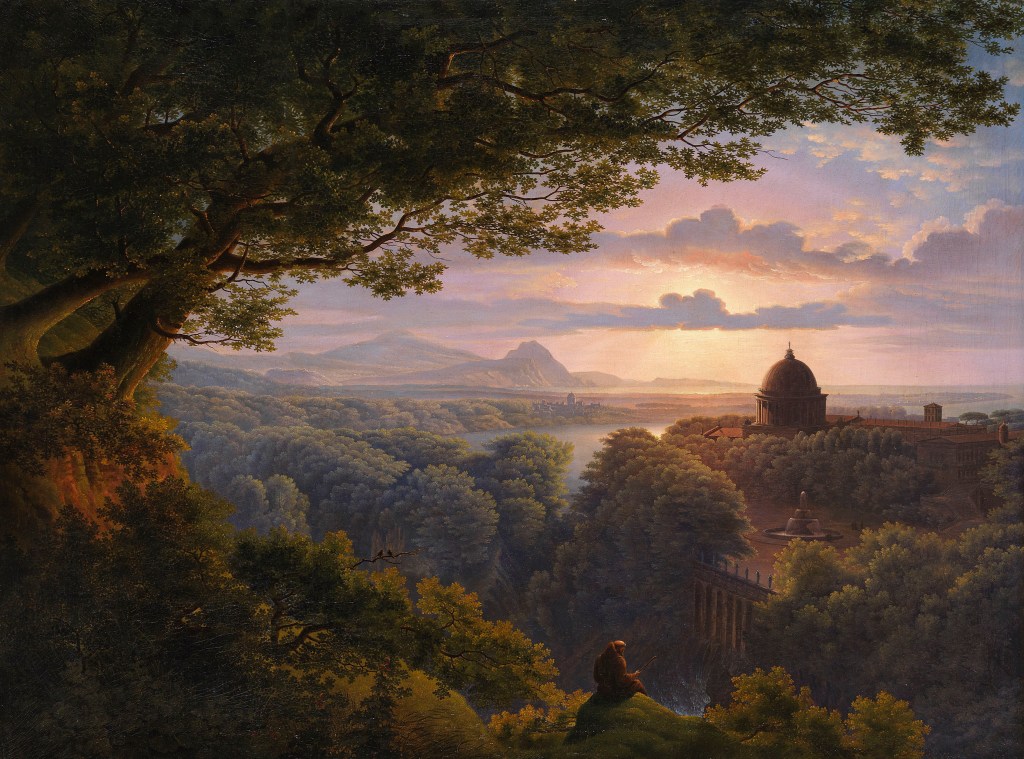
Written by: Ptolemy
‘Twin Peaks’
by David Lynch and Mark Frost
I sometimes wish there was more of David Lynch’s works before he decided to migrate onto whichever higher plane of consciousness he’s occupying now. Other times I realise it won’t help the selfish reason I wish he were still with us: that he would make or say something that would (at least for myself) allow everything to *click* together.
Lynch and his visions of the Weird, I have to remind myself, are the most colourful in shades of uncertainty.
But I do wish Lynch was still around because it would be interesting to see how he would tackle the weird new horizon of horror people seem to have become fixated on for the past few years.
I’m referring to the emergence of Liminal Spaces and the horror that is spawning around the spatial imagery of said spaces.
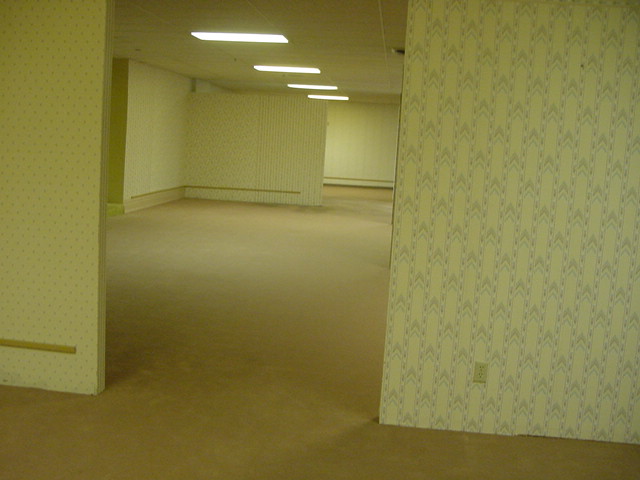
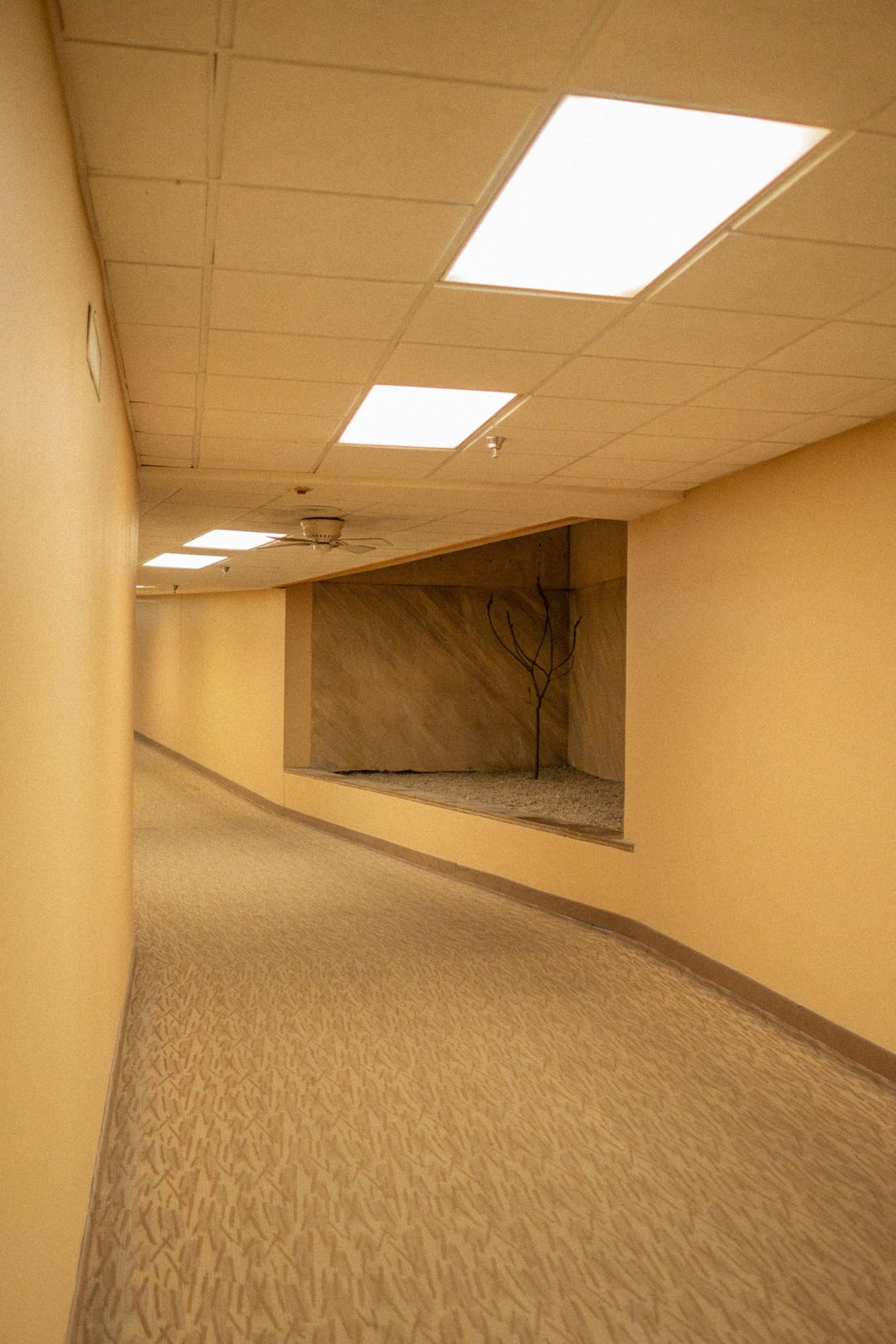
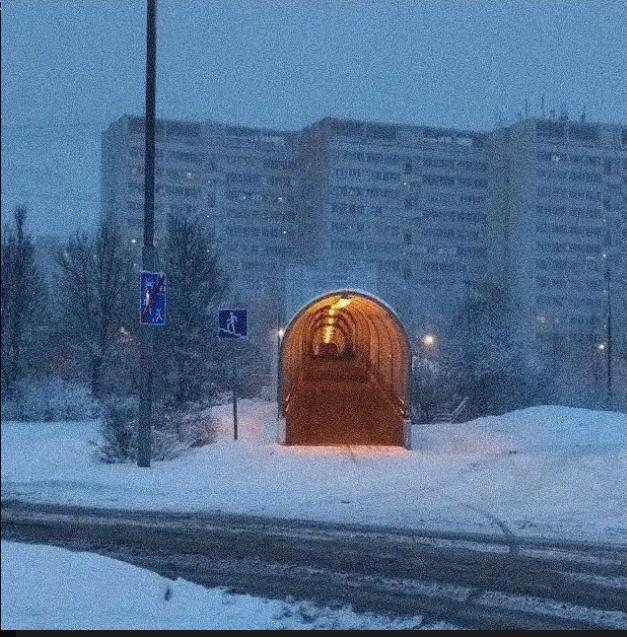
(Images from here1, here2, and here3, respectively.)
As of this writing, Studio A24’s “The Backrooms” horror movie is coming out in a few days; dozens of other indie video games have already built environments around images of lonely disjointed locales devoid of people and of history before this. It’s become the subject of a new horror/creepypasta craze. People didn’t really even know/care about what the word “Liminal” meant more than 10 years ago.
It’s interesting that it’s come up in this specific time, because (true to form) David Lynch played around his own exploration of such a concept decades ago. And arguably, he did it much better than most people today seem to understand.
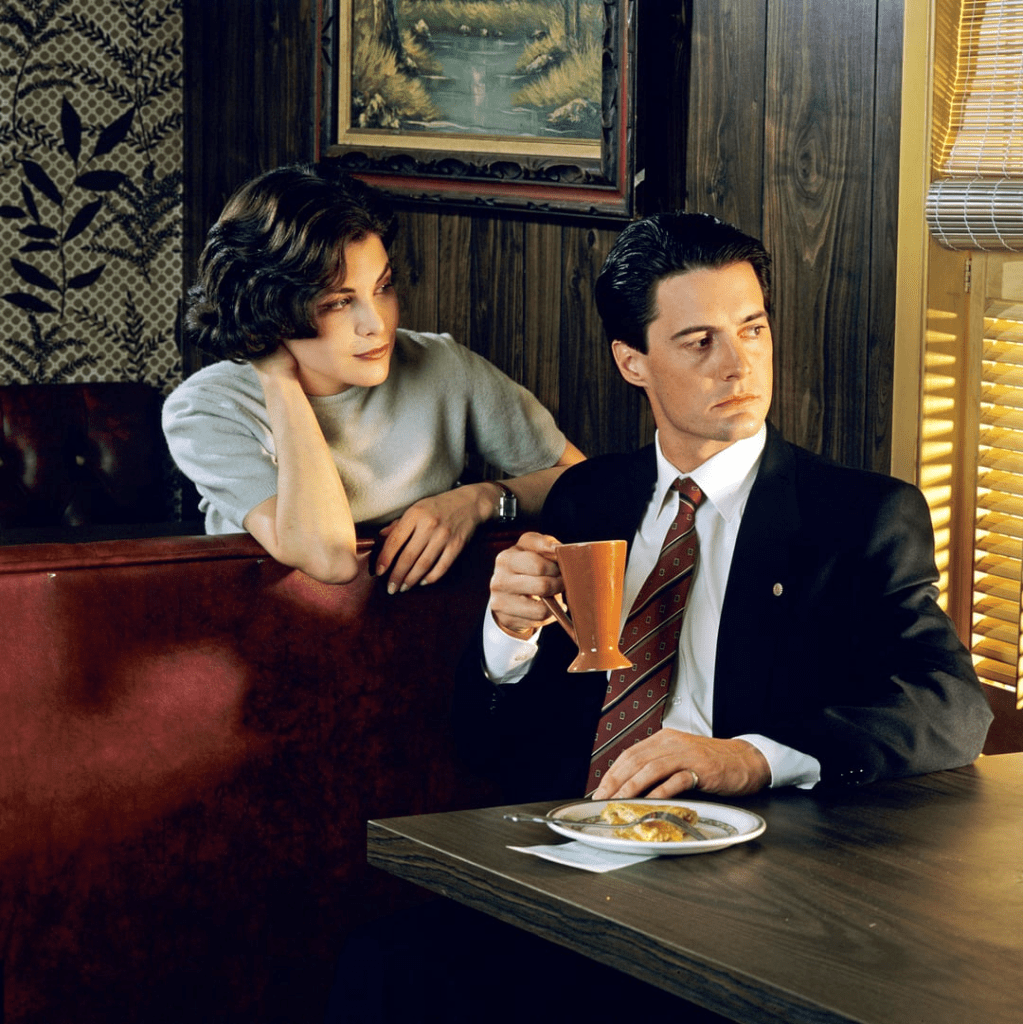
Twin Peaks is one of those stories where I wish I knew how to write more about it in a coherent manner. I can’t name a lot of shows that captured my imagination for the Unknown as well as Twin Peaks has.
(Image sourced from this Reddit Post on r/twinpeaks, and not the other stupid one asking if Cooper was a good person for turning down Audrey’s advances. If you have to ask, you seriously don’t get it. Favourite picture from the promo.)
Fans of the show and of Lynch have already said plenty, but I think there is still more to say and there will be more to say as time unfolds itself into a newer, weirder era. A new era where the weird old works become a new point of reference for sense-making.
Our new-ish cultural obsession with liminal spaces reminded me of the scenes where Agent Dale Cooper finds himself in a room with walls covered in red theater drapes and chevron floors. There are sleek seats, lamps and marble statues. Lights flash from nowhere. Silhouettes of things unknown float behind the curtains.
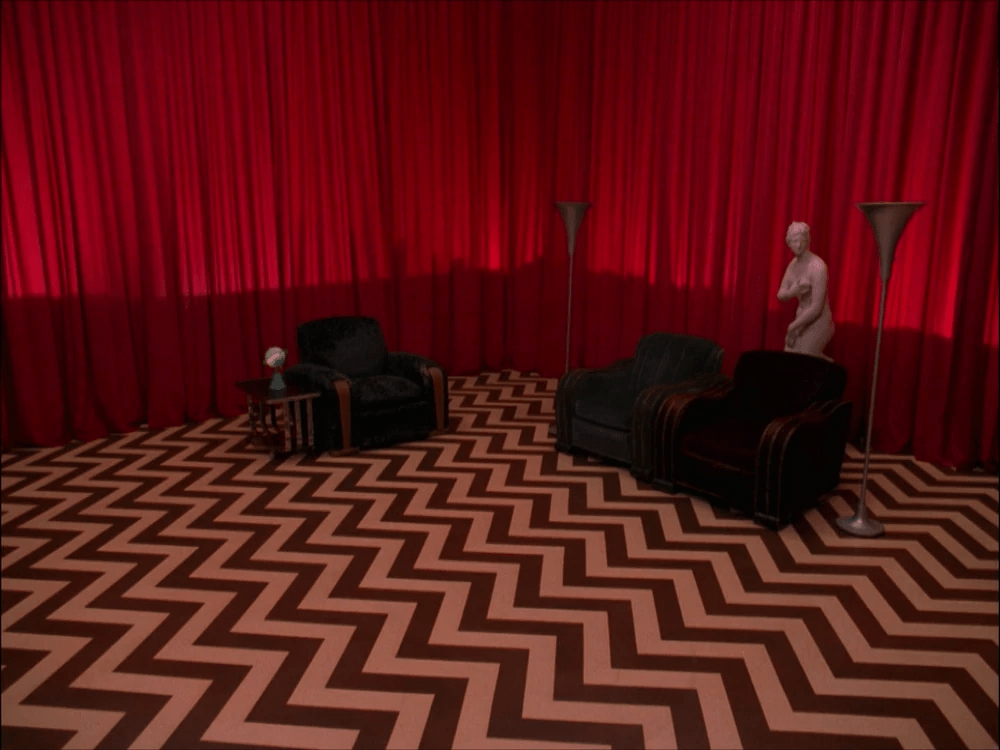
(Image sourced from the Twin Peaks Fandom Wiki. Those people do God’s work.)
The Red Room. The Black Lodge.
The first instances of these scenes presented a potent vision of a Numinous Gap within perception and reality; it’s become a form and an atmosphere a lot of people have tried to emulate with varying degrees of success.
Knowing this, I think the treatment of the newly-popular liminal spaces simply as “spaces” in themselves is a mistake. For one thing, we can argue the liminal space’s most numinous qualities originate from an aversion to mere occupation. A resistance to explanation and any personal addition or subtraction of meaning within that space. It’s meant to be difficult to physically enter and remain.
The first thing anyone does upon seeing a liminal space (or an image of it) is to imagine themselves exploring that location. They picture themselves being able to enter and take in the odd details (or lack thereof), and feel for themselves the eerie noiseless atmosphere of solitude.
The place is heavy with the feeling that something or some kind of meaning is supposed to be here, but isn’t. Or the reverse: something remains here, when it should have been gone a long time ago. It is this disjointed materialised detachment from a continuum of meanings which lends this quality. Rather than a place where things make sense in that forceful, rigid and contemporary way, the mystifying free-floating elements give way to the possibility of projecting a newer personal kind of sense-making. A context so fragile that imposing oneself inside it risks breaking the illusion it casts.
Therefore it is more appropriate to (staying true to the name ‘Liminal’) treat these non-places more as Holes and Gaps; localised interruptions within an otherwise seamless experience of reality and its accumulation of meanings. But more than that, the projected dream-like quality of that atmosphere maintains a ‘groundlessness’ wherein its meanings and semiotics float independent of any clause and attachment. It feels as much a gap of emotion, logic, and psychology as much as it is a gap in meanings.
If we accept the idea that the world today is made up of an excess of semiotics —an oversaturation of meanings— through daily personal responsibilities, ideas, messages, advertisements, social injunctions, etc, then the liminal space appears as a surreal gap within that excess. A spot where the meanings found in other places are slowed, staggered, and suspended. The excess of semiotics is paused. Going a step further, the liminal space represents an opportunity to escape from this excess of semiotics into a new textured kind of silence.
Several games imagine places like The Backrooms as a space to walk into and explore, masquerading with the label of “non-space” by virtue of its interstitial physical quality. Often it is located physically “between” places and contexts, for sure, but the ability for a player to explore does not immediately add to the allure which captured their interest to begin with. Many games shatter the feelings of slow morbid curiosity and disquieting allure by replacing the feeling with something immediate and demanding of attention.
“Liminal Space Horror”, for example, treats the liminal space almost purely as an outer zone of danger where evil monsters lurk. The fact that people are attracted to the idea of a liminal space is treated as a lure. A trap. This sudden introduction of tangible dangers simply designates the liminal space as another Place to escape from rather than understanding it as a Non-place between meanings. It takes for granted the otherwise alluring quality of the interruption, or they may even condemn the desire for an escape from the oversaturation of semiotics. The new “warning” of the liminal space game is to “beware the liminal space”, “don’t come here”, “enter at your own risk”.
Yet we cannot help but enter, even to our own detriment.
Mark Fisher’s exploration of H.G. Wells’ story The Door in the Wall reveals a reason why we can’t help but be attracted to the liminal space. Fisher points out a contrasting tension that exists between the busy but quotidian life of Lionel Wallace and a fantastical but transient existence behind an enigmatic Door in the Wall.
There is a sense of pure longing found in the failed escapes from the mundane through the appearance of the Door into a point-of-view that feels more “real” (or at least more appealing) than the reality we inhabit.
In this tale, the world on the other side of the Door is ethereal and passive rather than malevolent. Strange, languid, but not inherently evil. It’s slow and quiet. Over time, the image of this enigmatic door in the wall turns into an obsessive projection of emotional and psychological relief in Wallace’s constant and increasingly busy life. It represents an escape from the rapid and vapid humdrums of the real world, from the overwhelming build-up of meanings. An atmosphere it maintains through a contrasted dream “anarchitecture” of silence, if only a temporary one.
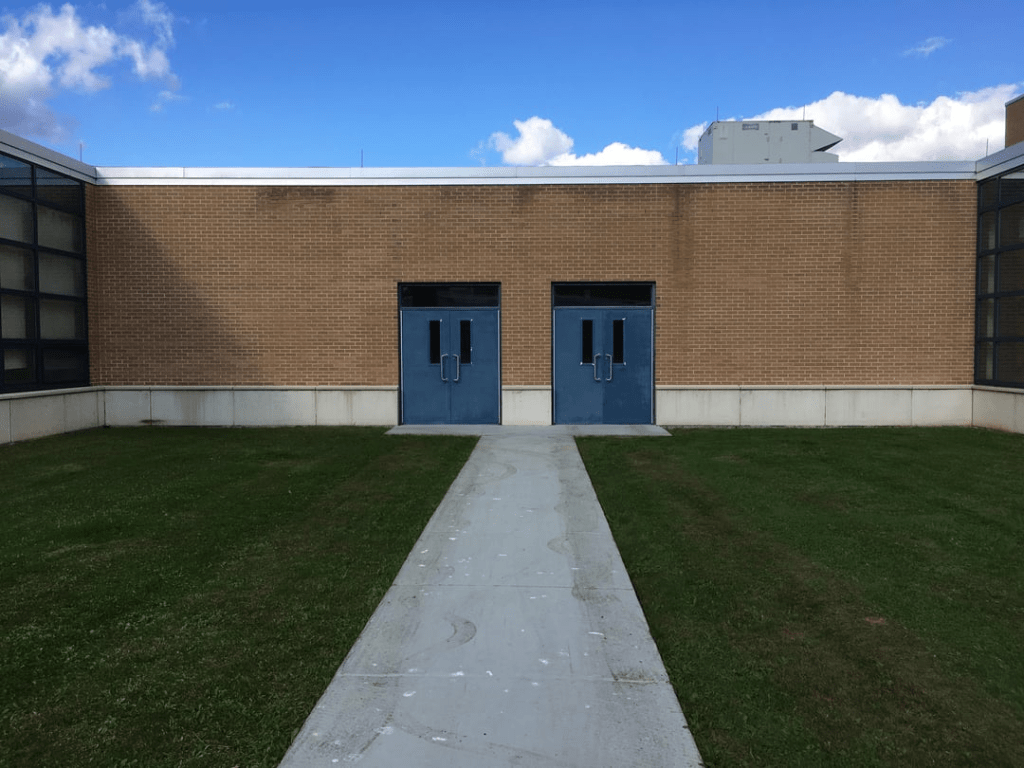
(Image from r/LiminalSpace by u/Cws3457)
This is partly why a lot of the liminal space horror games fail to hold my attention. Many do not represent anything liminal, as they are not actually in between any physical or emotional states. Some of the best-looking entries simply drop you into the dream-scene with the ability to explore its weird photorealistic surrealism, but fail to present a context of realism with which this surrealism is contrasted and where the sense of longing is formed. The initial feelings of awe and wonder rub off fast after walking through the same atmosphere of unconventional architecture again and again.
Other games try artificially injecting terror via monsters, but this does little to add to a sense of longing or the numinous that gives liminal spaces their appeal. It lacks the feeling which drew people to the idea of the liminal space to begin with, and thus tries to justify itself with an immediate emotional replacement and keep people engaged.
Returning to Twin Peaks and David Lynch. I don’t consider Twin Peaks‘s depictions of the Black Lodge to be liminal spaces (in the way we think of them now). Rather, they hit upon a similar atmosphere liminal spaces achieve where people suspend their personal preoccupations and embrace a new set of meanings (but a familiar set of emotions) within that phenomenological gap.
In Cooper’s exploration, the facts and occurrences in the real world are cryptically translated into unsettling disjointed messages in the Black Lodge and vice versa. Meanings seep in from the real world to float freely, detached from their usual structures or paradigms.
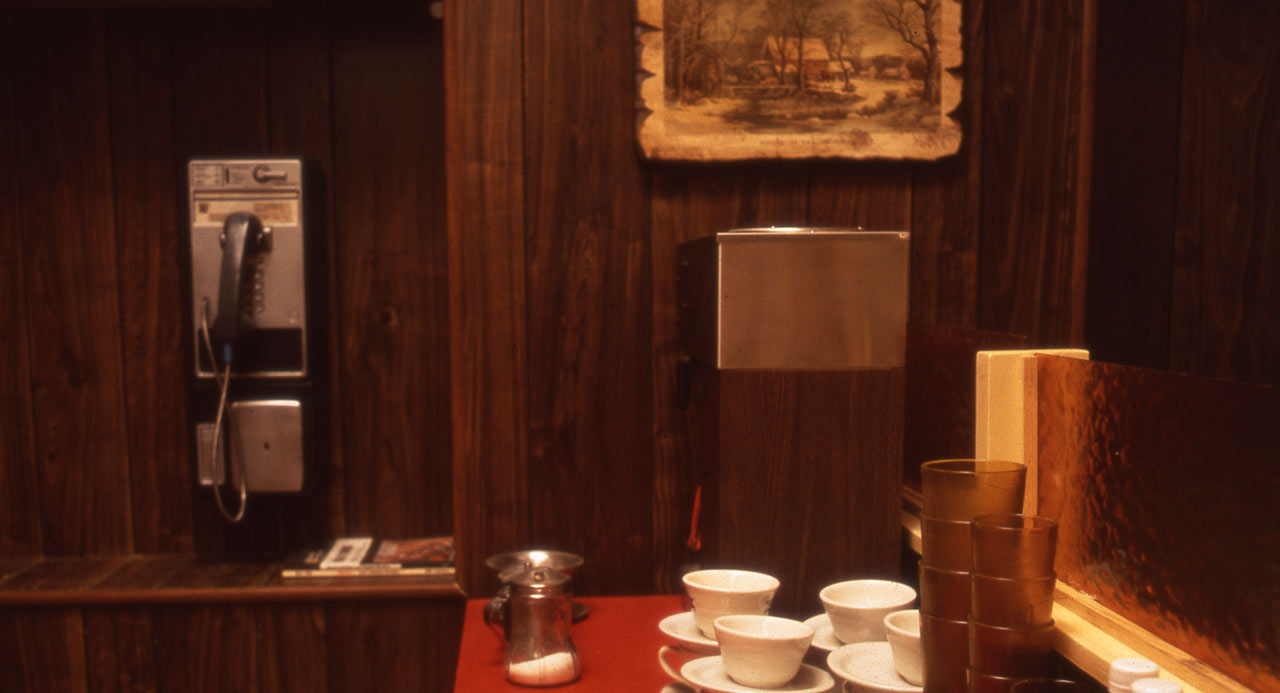
(Image from Twin Peaks Archive Blog)
Unlike liminal spaces that rely on an eeriness originating from a historical failure of Absence, Lynch included a certain sensuality —a cool feeling of Presence— that originates from (but is largely missing) in the real world except within people’s fantasies. It’s a clear tone within the atmosphere showing not all is pure danger or condemnation, but emotion and meaning. One that invites a new form of connection with the real world and ourselves, flaws and all.
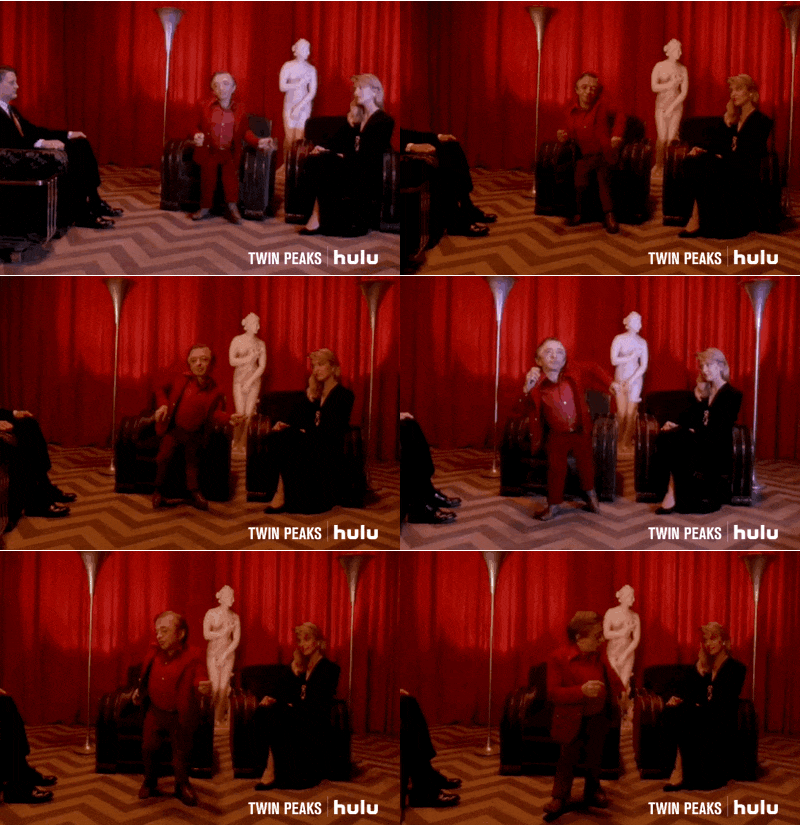
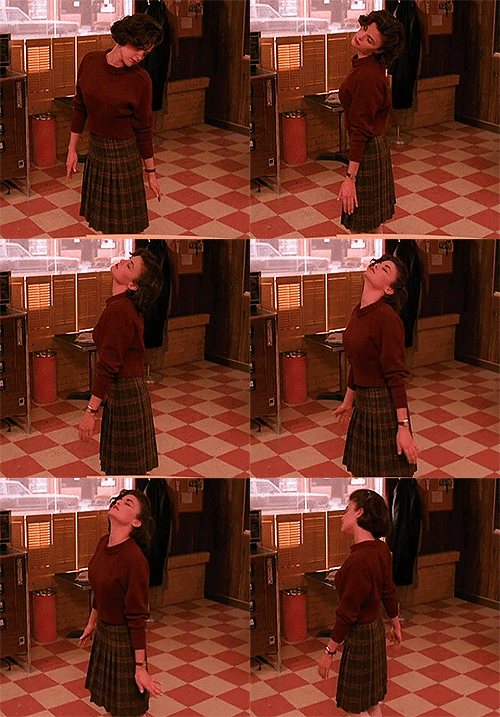
(Gifs sourced from Giphy)
Here, we see an opposite effect contrasting pure eeriness: eeriness is only ‘cool’ to be engaged with from a distance (such as on your phone or in a movie screen). You don’t actually want to be stuck in an eternal suspension of history, but you do want to indulge the longing for the temporary suspension of overwhelming stimuli (with the dread that you may be punished by unseen consequences for wanting to stay).
In Twin Peaks, characters walk into the mystery guided by their intuition and their longing, and trust that the unknown in-between harbours truth. Instead of trying to escape from the weirdness of the townspeople and their isolated, messed up lives, Dale Cooper’s only approach to solving Laura Palmer’s murder is to embrace the weird and the unknown. Parse its meanings through dreams, mysticism, and an open kindness. Meaning here is not suspended, only obfuscated and waiting to be reconnected. The real world’s complications on logic and feeling are only understood when Cooper embraces and faces them, rather than escape or condemn them.
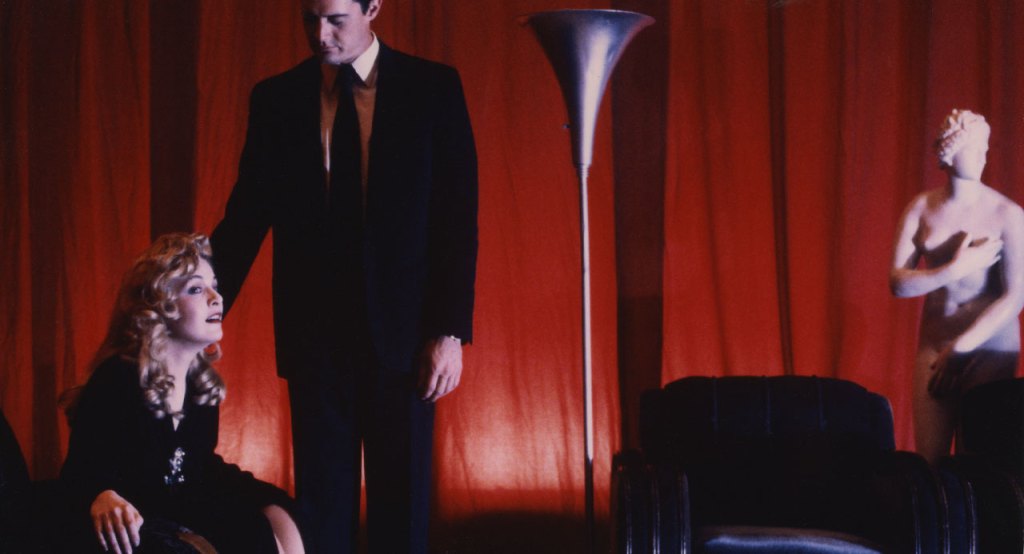
(Image from the Twin Peaks Wiki Fandom)
Liminal space horror tends towards a suspicion against the idea of liminal spaces. But if we were to look at liminal spaces as an expression of our fantasies for escape and relief, then the monster elements appears to be something that punishes the fantasy of escaping.
It should come as no surprise that a number of popular liminal space images are of lifeless, empty, and anachronistic workplaces. There is a disquieting pleasure in seeing such familiar places rendered vacuous and exposed of their true meaninglessness.
At the same time, liminal space images of nostalgic playgrounds, bygone entertainment venues, empty fields and school halls, manufactured pools of water, and wide open roads leading nowhere speak to a kind of feeling that is mostly lost in our normal experience of the present day, and replaced by the vapid cycle of overstimulating newer and “better” things. Monsters that lurk here here can be read as avatars of guilt and regret; perhaps a self-punishing guilt in fantasising that one can escape from the mundane and overwhelming realities of a contemporary work-life. Perhaps it is something else entirely.
The material point stands that these monsters stalk and chase people away from the liminal space. A condemnation in an expression of longing and the fantasy for relief.
Twin Peaks’ incursions into the Black Lodge display a share of monstrosities and evils following the progression of the show’s central mystery. Yet unlike liminal space horror, Twin Peaks demands its main characters face themselves, their fantasies, their flaws and their mistakes. Rather than a monstrosity of some impersonal alien morphology, Twin Peaks‘ evil is a confrontation with the Self that needs a feeling of Presence (not a preoccupation with Absence) to overcome. Fantasy, longing, sadness, and personal weaknesses become manifestations that need empathy and openness more than they need condemnation.
Nobody is really guilty of their fantasies, only of the lengths they went to deny, suppress, and destroy them. And even then, those punished need our understanding more than we need their destruction.
Twin Peaks is one of those stories I’ll need to return to in a future post with cleaner lens and a finer comb (and a damn fine cup of coffee and a slice of cherry pie). But even if the future entries dealing with liminal spaces don’t turn out exactly as my (armchair purist) expectations have set up, I’ve maintained that it’s a new genre with a thousand possible directions to go.
As much as they are a catalogue of our most prominent cultural fears and anxieties, the history of horror is also the history of our guilt and regrets. Just the same, they remain a door in the wall into a newer and more personal understanding of our own experience of history and reality.
I hope Kane Parsons’ exciting new entry into the genre will add to that understanding.
But let’s remember David Lynch was one of those few who did it first and, amazingly, did it very well.
— Ptolemy
Notes:
These attributions are put here because it would be too much to list every one of them under a gallery collection of images.
- Image from Wikimedia Commons. ↩︎
- Image by u/Which-Crab-638 ↩︎
- Image by u/DesperateAsk7091 (Deleted User) ↩︎
 Ptolemy Is Writing Again...
.jpg#/media/File:HobbyTown_USA_Oshkosh_interior_under_construction_2002_(The_Backrooms).jpg)
Leave a comment