Written by: Ptolemy
Janus amid the fields
It appears I’ve set up something new for myself, like a planter box outside the wide window of the room where I type these words. Fittingly, unknowingly, I’ve picked a terrible time in the changing seasons to declare the beginning of something new. January in the middle of April. I’d be a terrible ancient priest, or an alright one if you can associate April and its spring flowers.
This is the first in a series of mid-monthly ‘updates’: the little discoveries I’ve seen fit to haul to shore somewhat quicker than the rest. Things which are not too long that I spend entire weeks obsessing over them (Something about the blank electric field of computer screens, or something about Lacan and his capital ‘A’ Autre; blame one or blame both).
Books I’ve read, movies I’ve watched, songs I’ve grown attached to, games I’ve played (and not played), and essays I’ve started and will probably finish at some point. Every middle of the month, I’ll sum up my notes here.
If these were fish, they’d be the smaller ones, but at least they are fresh. Were this whole blog site a planter box, these are the succulents and I think they would be pretty.
‘The Weird and the Eerie’
by MARK FISHER
This is not the first time I’ve read Fisher’s ‘The Weird and the Eerie‘, rather it’s about the fourth time I’ve picked it up to flick through old tabbed sections, and the second time I’ve decided to sit down and read every chapter and every sentence again.
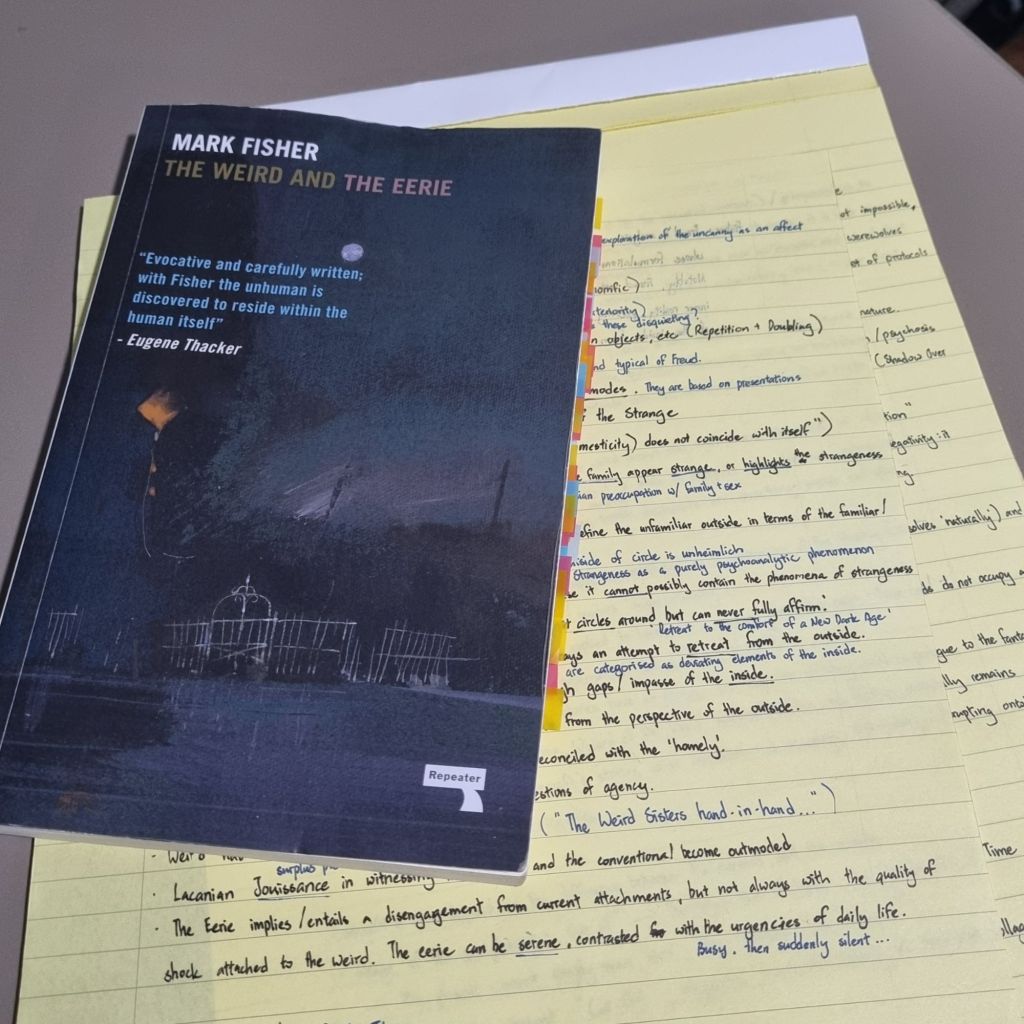
(Image by Me. Taken for illustrative purposes, of course.
I didn’t like the only pictures of the cover available online. They were not clear enough, and they lacked E.Thacker’s quote on the front. So I took one of my own copy alongside my notes.)
Time has its way of mystifying, but also clarifying the things we thought we knew.
As we’ll see in a later part, I hadn’t read enough Postmodernist fiction the first time and even in his most focused seminal works Fisher had a habit of referencing novels and art not especially well-known outside the English-speaking Western hemisphere. It’s a frustrating habit among theorists and philosophers to be so comfortably ‘intertextual’ but you get used to it, and it gets better the second/third/Nth time around.
Fisher offers a definition of The Weird and The Eerie, but in a very exploratory manner. He starts off with a critique of Freud’s concept of ‘Unheimlich’ (rendered, poorly some may say, as ‘Uncanny’ in English) and of the Psychoanalytic treatment of the ‘Strange’ within the Familial structure. Fisher dives into more comprehensive definitions of the Weird and the Eerie, formulating them around “impossible” presences, around failures of presence and absence. An illustration that what’s possible and impossible, what’s realistic and unrealistic, what’s strange and mundane, become confused.
The rest of the book unfolds into this winding and eclectic tour of different aspects of the definitions he offers at his introduction. From Lovecraft, to David Lynch, to Du Maurier, and to Kubrick. The definitions expand into newer territories of thought at Fisher’s invitation, wanting us to follow along and see if we could offer more examples or aspects to add on.
It should also be noted that, for a book published in 2016, I think Fisher’s concepts handily explain both the emergence of “Liminal Space” horror, and what’s often overlooked or lost in pursuit of this new mode of horror (but we’ll get back to this).
A lot of people know of Fisher from his more famous work, Capitalist Realism. It’s a love-hate affair online; quite a number love him for it, others dislike him for varying reasons, not least of which is the negative tone in Fisher’s analysis of contemporary Capitalism and how Capital shapes notions of ‘realism’.
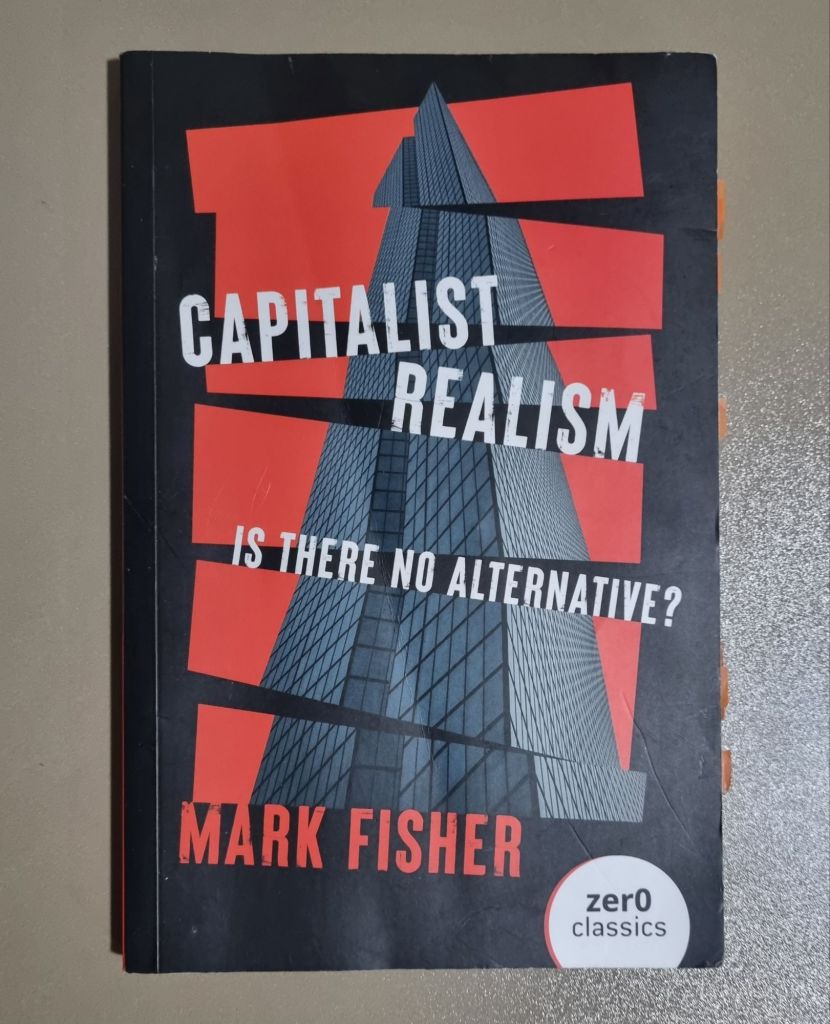
While I can agree he’s not for everyone (because who is?), a prevailing sentiment is that Fisher was too pessimistic in his analysis that there might be ‘No Alternative to Capitalism’. That there might be no more new avenues for humanity to progress beyond mindless capitalism and all its accumulated negativities. The melancholy title and subject matter of his other work, Ghosts of My Life, appear to corroborate this criticism.
But to me, those critics seem happy to forget that the last passages of Capitalist Realism call for hope in the idea that there are alternatives to the bleak, dark, and ‘realistic’ world we find ourselves in:
"The long, dark night of the end of history has to be grasped as an enormous opportunity.(...) The tiniest event can tear a hole in the grey curtain of reaction which as marked the horizons of possibility under capitalist realism. From a situation in which nothing can happen, suddenly anything is possible again."

- Capitalist Realism, Chapter: "Marxist Supernanny"
And this hope is realised (at least partly) within The Weird and The Eerie. It’s typical of us to hope for the better on our own conventional terms. But Fisher’s body of work articulates how the unconventional and the Strange, which human systems are quick to denounce as impossible and evil, have things to show us about ourselves and about possibility. It displays the idea that we can yet find hope in the miraculous, the ‘unreal’, and the impossible instances of the Weird and the Eerie, and allow ourselves to wonder what else was possible all along.
-Ptolemy
 Ptolemy Is Writing Again...
Leave a comment