Written by: Ptolemy
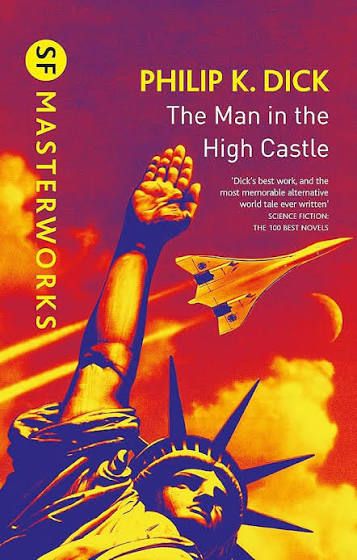
Question: Have you ever read Philip K. Dick’s The Man in the High Castle?
The past few years have taught me to be specific with the wording of this question. Because even if the answer is “no”, a very cursory explanation of the novel’s premise allows a lot of people to assume that they have some idea of what the novel is about.
The Man in the High Castle‘s basic premise: It’s the 1960s, and instead of the Allies, the Axis Powers won WWII in 1945. The former United States of America is partitioned into the Imperial Japanese-controlled “Pacific States of America” on the West Coast, the neutral Rocky Mountain States in the middle, and the Nazis control the states along the East Coast.
In this alternate 1960’s Imperial Japan and the Nazi Reich are locked in a Cold War all over the world, with the former United States and parts of South America being a major focus of their geopolitical struggles. Elsewhere, the Nazis have developed and used the hydrogen bomb, drained and converted the Mediterranean into arable land, and begun efforts to colonise other planets. An aging Hitler went mad with syphillis, Martin Bormann is in charge and losing power, and the other prominent members of the Nazi Party attempt to depose one another as future Chancellor of the Reich.
Reading all of this, there’s no doubt a twinge of recognition and maybe some ideas popping up in the minds of some people.
Those who’ve played the Wolfenstein video game series, for instance, have some visual frame of reference for a Nazi-fied world, down to its radical terraforming of Earth’s seas and the fanatic conquest of outer space.
This possible frame of reference goes beyond the retro-futuristic dieselpunk German technology. Nazi ideologies have permeated —or hijacked, is perhaps a better word— the familiar cultural milestones of the sixties. The Beatles sing in German. Talk shows discuss Nazi excellence while extolling the mass extermination of “inferior races” in the same breath. Diners and automats, visual touchstones of the mid-century, look and feel lot more German than American. The material appearances and cultural architectures of the sixties look off without the contributions of the other races that cement its significance in our history and saturated with white European imagery.
Being unfamiliar with the Wolfenstein games doesn’t disqualify anyone from this tendency either.
James Gunn’s second season of Peacemaker recently reintroduced Earth-X. Marvel comics has Earth-597 and 98570. Let’s not even speak of the disappointingly mediocre Amazon adaptation of The Man in the High Castle.
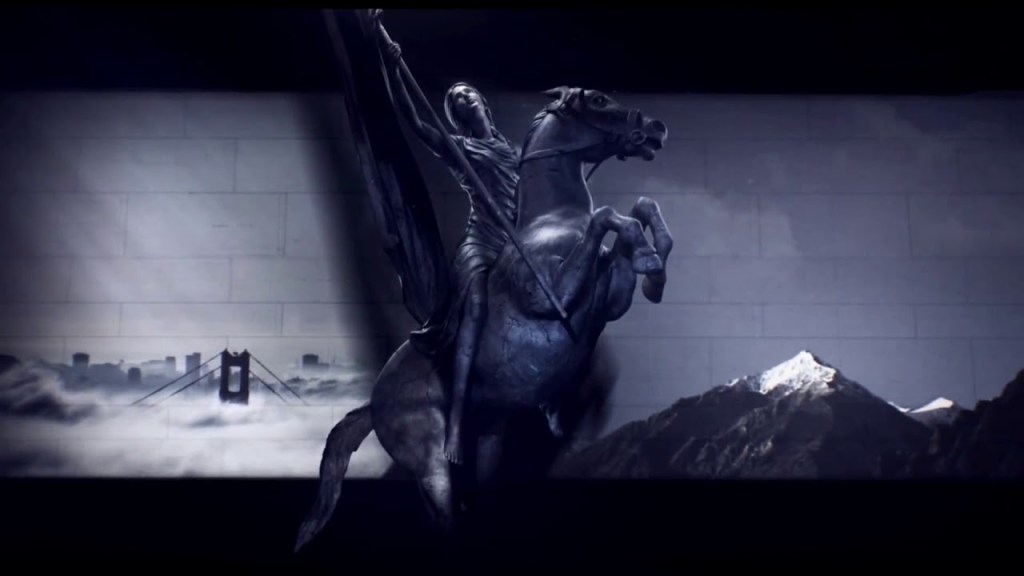
(Image from the Amazon adaptation of The Man in the High Castle. The show was disappointing, but even I have to admit the intro is a damn masterpiece)
In popular literature Orwell’s 1984 and Huxley’s Brave New World begin with realities oversaturated with authoritarianism’s violent and vampiric modes of control over human behaviour (though with different approaches), starting with a basic ontological assumption that they originated from a point where “the wrong side” won. It only proves the historical ‘what-if’ is by no means an original premise.
A world or an alternate history where an ultimate evil has triumphed over good is easy to conceptualise, largely as a warning and a lesson on ‘how good we have it’ here and now in the real world.
Today, with the widening threat of right-wing fascism looming over the world again, there has been much ‘gesturing’ towards books of these stripes as warnings against the dark potentialities of fascist governments and oppressive regimes. The more atrocious, appalling, and disturbing its depicted dystopia, the more people swing it about like a warding bell against the phantoms of fascism.
Disquieting tales of dystopias where the ‘ultimate evil’ of Nazism/Authoritarianism has won are recruited to this activity; The Man in the High Castle is sometimes among them, with the expectation that it criticises fascism and its violence with the same zeal as any other story about authoritarian violence. It is supposedly a book about a world where the Axis powers have won, after all.
So it might surprise some folks to realise that The Man in The High Castle‘s what-if story is not really about the evil inherent to the Nazis or the Imperial Japanese per se, nor does it criticise fascism or authoritarianism in any straightforward manner that will serve this purpose.
In fact, the Nazi and Imperial Japanese occupations of America are not even the most interesting part of the book’s story. That premise is merely the context of its narrative.
Already at the risk of relying too much on negations to make my opening point: The Man in the High Castle is a lot of things, but it is not a ‘good’ warning against the evils of fascism.
There are much better books for that purpose.
The Man in the High Castle instead posits bigger questions about reality, fascism, and our individual and collective relationships to history. Beyond the usual dystopian focus on violence, its meditations are about the melancholy of something missing from both that twilight world of totalitarian triumph and our own ‘real’ world: the metaphysics of possibilities.
Metaphysics is dead, and we have killed Her;
Perhaps now is the time to call Her back to Life.
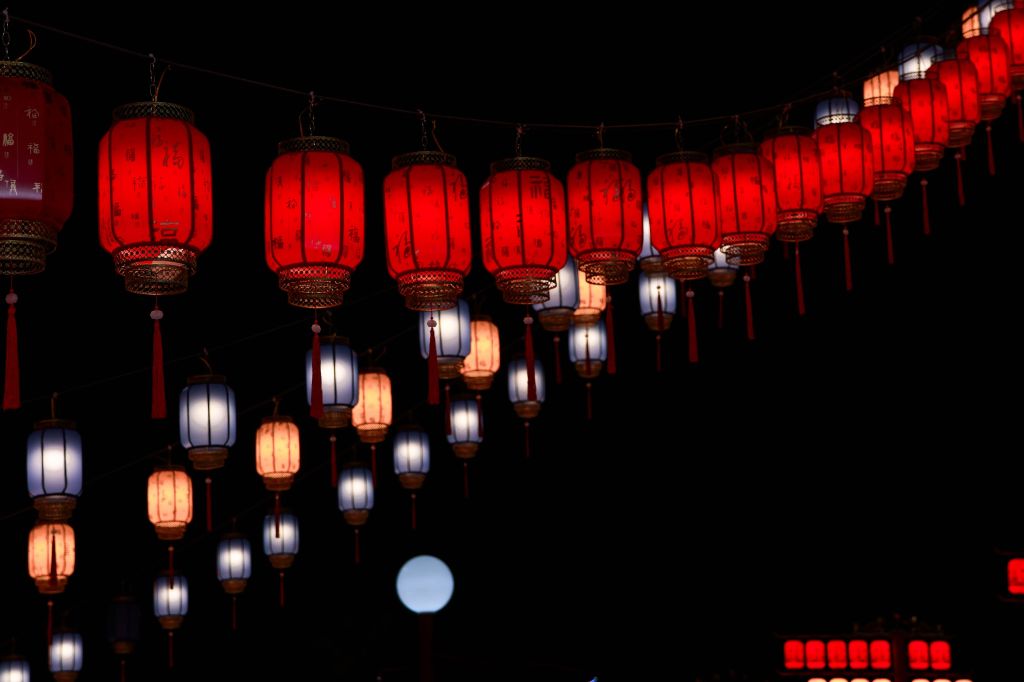
Image by 浪郭 on Pexels
There was a time when I was younger, an elder of some tenuous and distant relation in my family (can’t exactly remember which) told me the tale of why our people celebrated 中秋节, the Mid-Autumn Festival. Many details from that time are nebulous half-remembered whispers seeping into my perception whenever that season arrives, but I remember the story.
I remember, because it was never just one story at all.
You may find more coherent versions out there. You may have your own versions with your own details. But here they are as they were passed to me:
In the ancient past, ten suns used to cross the sky. At first one at a time, day after day, to bring light and warmth. One year, all ten of them arose into the sky together and their fire brought disaster across the world. On the Jade Emperor's orders, the archer 后羿 ("Hou Yi") took up his bow and shot nine of the ten suns, leaving the last one for light and warmth.

With gratitude and admiration for his heroism, an immortal from the heavenly court sent 后羿 an elixir of immortality. But as he was unwilling leave his wife 嫦娥 ("Chang'e") alone in the mortal world, 后羿 gave her the elixir for safekeeping, promising he would never use it to part from her. One day 后羿's greedy apprentice 逢蒙 ("Feng Meng") broke into 后羿's home and forced 嫦娥 to give it to him. When 嫦娥 refused, she swallowed the elixir and floated into the sky as an immortal. Unwilling to be forever parted from 后羿, she settled on the Moon and became its goddess, so 后羿 would always be able to see her.

Thus on the night when the full moon is at its brightest, the people gather to celebrate the love between 后羿 and 嫦娥 by making mooncakes and lighting paper lanterns, so that the glow of their light may be seen from the heavens.
That was the first I heard of the myth, until I heard another version told to me by that same elder. Perhaps on the same night, or maybe it was on a different Mid-Autumn night. It all comes back to me in the same echoing whispers now:
After 后羿 slew the nine suns and left the tenth to continue bringing light and warmth, the people of his village celebrated his heroism and began to revere him as a king. But 后羿's reign soon blackened into tyranny, and the people began to fear and suffer his many caprices. Though he was cruel, the people persisted in their reverence, as he was the man who slew the nine suns.

One day, an immortal sent 后羿 an elixir of immortality as tribute. Fearing her husband's subjugations would persist forever, 嫦娥 made a fateful decision. She stole the elixir before he could take it and swallowed it as he pursued her. As she floated into the sky, an enraged 后羿 took up his bow and fired but failed to kill her.

Thus on the night when 嫦娥 glows brightest, the people gather to celebrate her heroic actions with mooncakes and paper lanterns, so that people may be grateful for what they have now instead of what could have been.
I remember preferring the latter version of 嫦娥’s tale, owing to the intensity of the way I remember it recounted. Even as a child, I could sense this version meant more to my storyteller than I could understand.
Yet now I had more stories of the same event than I knew what to do with. Two versions of the same myth; the ‘same story’, but not really.
As any student of mythology understands, it’s certain that there are no ‘canon’ versions of any myths. Only consistencies and anomalies within each version it is experienced; same as dreams, same as our individual and lived experiences of History.
In such cases, we’re apt to not think of them as “myths” at all but to simply take them as a fact within a wider framework of ‘oral history’. I couldn’t and wouldn’t raise a finger to contradict that elder, even if this story was told to me today. It’s fascinating. It shares a kind of history that harkens to a now-surreal and lost context of linguistics, materiality, and metaphysics; a nebulous fantastical view of the world that feels so far away from us, here and now, even though it’s said to have happened on this same planet.
Despite this distance, I used to guess. Was there any version ‘truer’ than the other? What were the events that inspired the first tellings of the myth?
I reflected on the small moments of hope and tenderness present in the former version, and wondered which telling came first. Wondered why that latter tale I preferred growing up was not half so tender. And failing to conjure a satisfying answer, I just asked more unanswerable questions: “do you think 后羿 ever regretted or resented how things turned out as he looks to the night sky?”
What would that tragic pair think of their tale being an inspiration to dozens of love stories all over East Asia and beyond? Or a tale of a woman making an ultimate sacrifice against a person she once loved? Would they have preferred it if the former rather than the latter version were true?
What would they think now, under the full moon’s light, of all those things that could have been which never came to pass?
For the Moon never beams, without bringing me dreams
Of the beautiful Annabel Lee;
And the stars never rise, but I feel the bright eyes
Of the beautiful Annabel Lee;
And so, all the night-tide, I lie down by the side
Of my darling —my darling— my life and my bride,
In her sepulchre there by the sea—
In her tomb by the sounding sea.

The closing stanzas of "Annabel Lee" by E.A.Poe
Here’s what The Man in the High Castle is really “about”:
Throughout the story, characters read and reference a book titled ‘The Grasshopper Lies Heavy‘, an alternate history novel detailing a world where the Axis Powers lost WWII to the Allies. The book is banned in Nazi-controlled regions of the former United States, while the Imperial Japanese allow its publication and sale in the Pacific States.
The enigmatic and reclusive author of The Grasshopper Lies Heavy is the titular ‘Man in the High Castle’, Hawthorne Abendsen, so named because the publication of his novel has made him a target for assassination in Nazi-controlled states. Indeed, one of the characters in the story is a spy dispatched to kill him.
Parallel to The Grasshopper Lies Heavy characters also use and frequently reference the I Ching (易经,often translated as “The Book of Changes”), a Chinese divination text to clarify their situations and guide their actions. Hawthorne Abendsen later explained he’d used the I Ching to guide his writing of The Grasshopper Lies Heavy, while other characters make decisions and things based on what the I Ching reveals to them.
Against the backdrop of this dark and twisted world, The Grasshopper Lies Heavy reveals a transgressive yet familiar version of their own story/history. The Nazis and the Japanese are defeated. The world’s cultures develop without the impositions of Nazi or Imperialist Japanese ideology while the many races that are persecuted continue to survive and thrive and contribute to this alternate ‘perverse’ history.
The dramatic events it illustrates are said to be fictional, with many characters repeating this assurance to each other as they discuss its bizarre events. However, the more they read, the more they cannot help but be fascinated with its inversions and latch on to a certain quality of truth present within the novel but absent within their empirical experiences of reality.
To me, there is no clearer example of the role of this than when the ‘real world’ decides to make itself known to one of the book’s most politically entrenched characters.
Late in the novel, the character Nobusuke Tagomi (a high-ranking trade official in San Francisco) experiences a spiritual moment where he disappears from his own history and glimpses the one described in The Grasshopper Lies Heavy.
Shaken that he’d just killed two SD agents with his ‘antique’ pistol, Tagomi went back to Robert Childan to try and sell the gun back to him. Tagomi is instead drawn to a few pieces of jewellery another character had made. He senses that the jewellery was crafted with intense spiritual energy, as they were created based on guidance from the I Ching, buys them, observes one of its pieces in a park, and finds himself within an alternate version of San Francisco.
A white policeman asks Tagomi if he’s playing with a little puzzle, which he thinks is socially inappropriate that a white man should interrupt him. He is taken aback by (of all things) the Embarcadero Freeway, a piece of the city that is absent in his own version of history. As he walks along he quietly remarks that San Francisco looks duller, with a smoky “tomb-world cast”; there are no “Pedecabs” (which are supposedly rickshaws or trishaws the lower-class Chinese citizens of his history manually pedal up and down to transport people), only large and brutal metal cars.
When Tagomi enters a diner full of people, he is surprised that none of its white patrons yield their seats to him (as they do in his history).
“Watch it, Tojo,” growls one of them as Tagomi insists upon it. Tagomi is appalled.
This world doesn’t share his values. It’s the same place, San Francisco, but not the same history. And it’s more than he knows what to do with. It’s so eerily different that Tagomi believes he’s dead, or is catching glimpses of an existence akin to being dead.
“Bardo Thödol existence.”
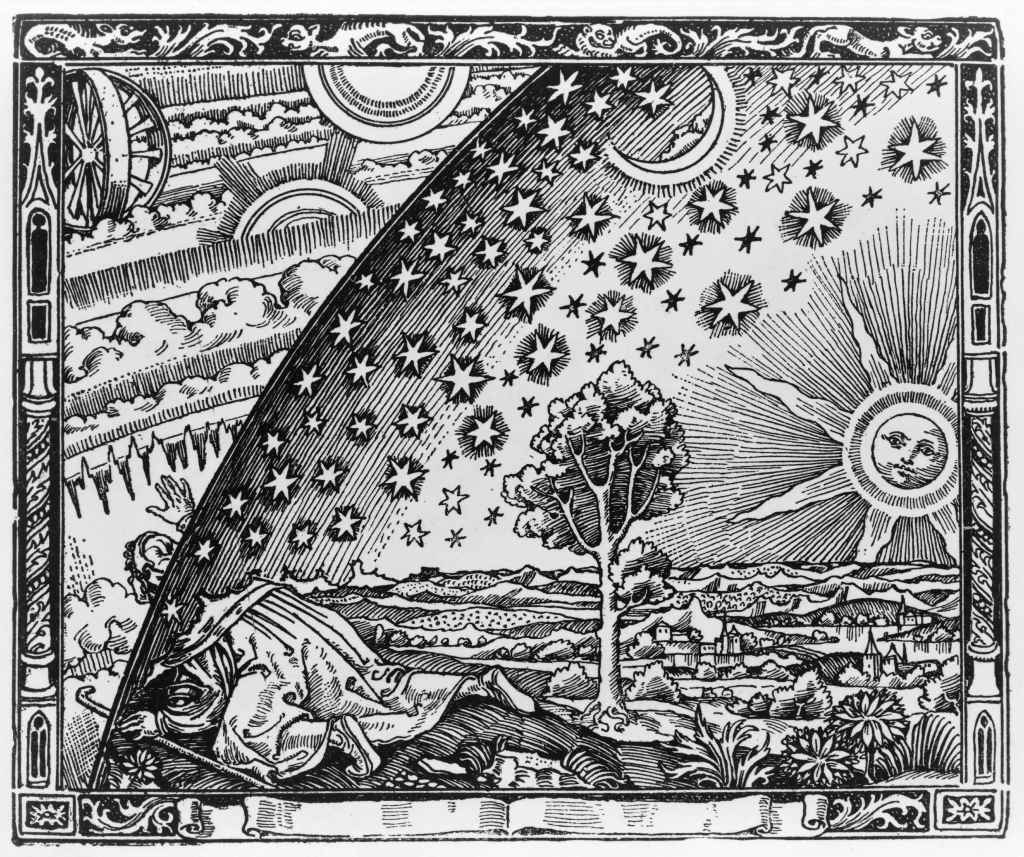
The Flammarion Engraving from Wikimedia Commons
Tagomi peered out the threshold of their reality into a point-of-view that betrays how ‘false’ their world feels in comparison. Even though the supposed ‘real world’ is ugly and incongruent with Tagomi’s experience in his own history, they still feel viscerally banal and authentic. Akin to the philosopher stepping out from Plato’s Cave, Tagomi sees a history that is ‘real’ but is shaken at the revelation that he could not longer perceive his own history in the way he did before. His original reality is full of deficiencies which he feels but cannot articulate.
The effect The Man in the High Castle illustrates, with the metafictional nature of The Grasshopper Lies Heavy, is that this alternate world/history perceives and defines itself as otherwise relatively ‘normal’ from its own standpoint. The same way we’re all apt to assume our own perceptions and views to be ‘normal’ until something appears to disrupt that perception. It’s the metaphysical equivalent of meeting someone “better” than you, and despairing over lacking something which they have.
Its bizarre conclusion of the second World War with the Axis Powers as its victors and its consequent social effects re-defined the boundaries of ‘realistic’ and ‘unrealistic’, ‘normal’ and ‘abnormal’, ‘right and ‘wrong’. Defined in a such a mode that I don’t believe we could conduct any productive discussion on these categories beyond the fact that these are all relative to the structure of their history.
Unlike the many other dystopian novels mentioned before, we’re not drawn on to instantly demonise the world or the regimes depicted in The Man in the High Castle because we’re meant to consider that our own historical axiologies have little value in this alternate version of history; no more than their ideals have any serious value or impact in ours. Despite the fact that Black people are enslaved and the Chinese are subservient second-class citizens while Jews and other races are exterminated, we’re put into the shoes of otherwise “normal folk” as we’re meant to experience the banality of this existence more than its cruel edge. See and judge the perceptions of those who allow, rather than fall victim to, the so-called ideals of this twilight world.
And from there, come to question and expand our approaches to perceiving the course of the history we’ve come to know and be shaped by.
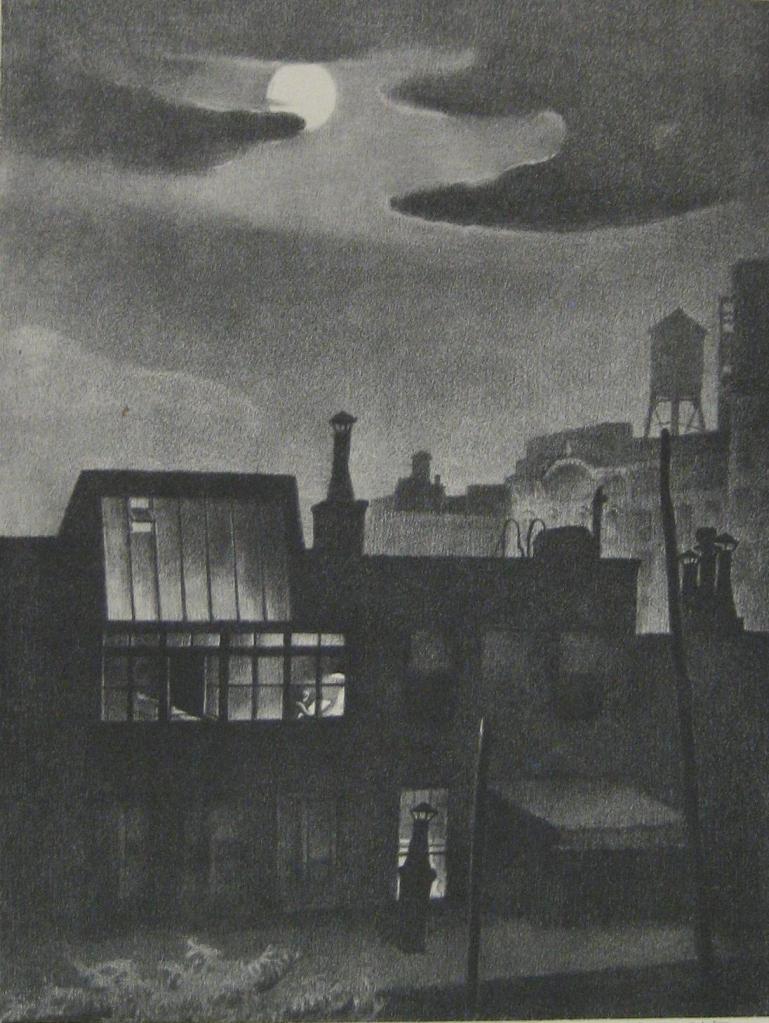
Night Work by Mabel Dwight, 1931
There is one last surprise in the novel: Even though The Grasshopper Lies Heavy describes a “true world/history” where the Axis Powers lost WWII, Abendsen/PKD does not describe our world.
Not in the slightest.
The Allies win because a President Rexford Tugwell sidesteps Pearl Harbor, and the ‘real world’ turns on to a new Cold War between the British Empire (led by an aging and concentration camp-loving Churchill) and the United States. The Nazi Party are tried as war criminals, and Hitler executed. The New Deal helps make Africa and China less poor, while the Malay States are seen harbouring enterprising Chinese dissenters against the British empire.
Despite its (admittedly wacky) details, it’s the difference that counts.
Our history, PKD psychadelically implies, is but another perversion/reflection of another that is more “real”. Another parodic parable for a world warding off the evils infesting our own. A flawed emanation of a grander presence. A shadow on the wall.
But it’s hardly the Fact that works in fiction, the Feeling cuts far deeper.
Arguably, the most poignant part of reading The Man in the High Castle is not something you can find written within the book itself, as none of the characters had any metaphysical standing or reason to say it:
How could they do it?
How could the people of this world live like this? How could they accept the Nazis and the imperialists into their lives, just like that? They could have fought, and instead it seemed the whole world just moved on. Moved on from everything they were once so proud of being, like it was just a phase to be corrected, a lapse of character.
Are they not heartbroken? Do they not grieve what we know could have been?
The answer is that no world can afford to be heartbroken over something that never really happened.
One can be only melancholic over what you hoped could have been. A child could have been born, a pair of strangers could have been friends, A dead man could have lived, a woman could have been freed, and a husband could have been tender.
The World could have been a better place.
It tells you that there exists a version of the world that is a better place; it just isn’t Here. It tells you that you once had every possibility, and that the possibility of becoming that specific, better world has long passed. That this loss/never having it to begin with was the natural order of things. You can want for it to be a kinder reality at this moment, but only way to have a kinder reality at this very moment was for reality to have been kinder in a time that is now gone.
I argue The Man in the High Castle‘s most salient points hinge upon this melancholy. The knowledge of former possibilities lost within the gnostic accumulation of everyday banalities and evils.
Therefore it’s a lot more nuanced than “Ohhh, Nazis in America. That means this book predicts future of our politics. Hurr durr.”
The book reads more as a story of a ‘normal’ world interrupted by visions of another world that is more ‘real’ than it, and asks its characters (and its readers) if its values and personalities are as rigid and certain as the characters pretend they are. It asks if these values that were chosen (either by others before us or by ourselves) were worth never having what you could have had instead.
Same myth, two stories.
With much of the general mood throughout the world consigned still to the fatalism, the cynicism, and the hopelessness characteristic of Capitalist Realism, the small moments of imagination that fuel the melancholy of a world that could have been different adds no relief to the spiral of unanswerable questions about ‘what could have been’.
Whatever it was that happened to the world of The Man in the High Castle has happened to our own. We get a looming sense that, somewhere along the line, our history blackened into its current twilight form where it should have blossomed into something.
Our 后羿 has turned into a tyrant, and we’re letting him persist.
If this isn’t already an obvious feeling or sentiment in the West, it has been painfully obvious to the rest of the world where most people are deprived of the luxuries reaped from a cultural and ideological dominance of another power. It is obvious to the countries that the western nations bankrupted, deposed, sanctioned, and destroyed. It’s obvious to the communities of people who are marginalised and persecuted. It is obvious to people who didn’t get to choose what they lost and what they never had.
And the default reaction is numbed nothingness. There is nothing left to do, nothing left to think, save for “what’s the most practical/’realistic’?”. Who can afford those kinds of fanciful distractions? Who can be heartbroken for a world that never came to pass?
There’s no room left for metaphysics here. Not in the world of The Man in the High Castle, and not in ours. Though the characters speak of Eastern philosophy and mysticism, it’s evident that their way of life is shrinking into itself and doomed to disappear as their world develops newer and more effective (invasive) technologies and the dominance of their own political ideology continues to grow.
Which begs the last question PKD never had a chance to answer: in a version of history like that, what happens next?
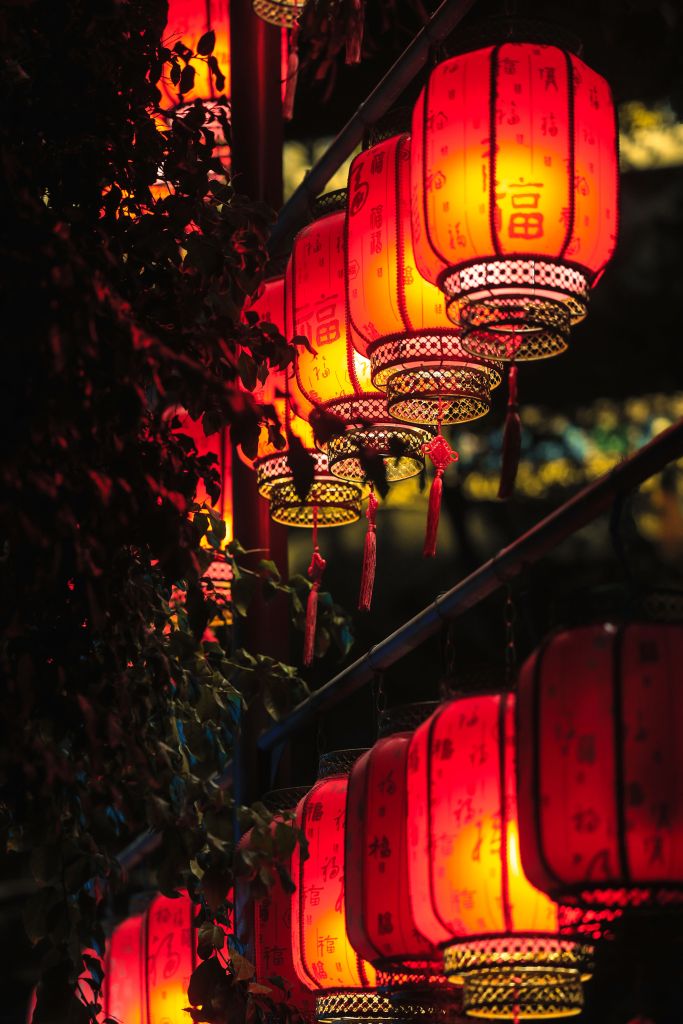
Image by Andy Lee
Mid-Autumn had always been a rather lukewarm festival in my corner of the world. Its yearly approach is remembered on our behalf through the supermarket spreads of mass-produced paper lanterns and cloying machine-stamped mooncakes.
“Oh yeah, Mid-Autumn’s ’round the corner again.”
There’s not an official holiday gazzetted for the ocassion, and an embarassing number of people who live alongside our culture think we eat mooncakes and carry paper lanterns for the Lunar New Year. It’s not as intense a time for lovers in the same way it is elsewhere; there are other occasions more romantic.
And we don’t even have Autumn in this corner of the world.
What we do have within the small pockets of our culture is a celebration of one of our oldest and most mysterious celestial companions. Granted, there are bigger celebrations in places with larger Chinese communities that (with enough money) try to make it as big a deal as it is elsewhere in Asia. But for many it’s a contemplation of the oral histories passed down to us about what once was, and an appreciation for the beauty of the things which are and could have been.
It’s an ethereal occasion. It’s not loud as the Lunar New Year, not as focused as Christmas, not as reverent as Eid-ul Fitr, nor as colourful as Deepavali/Diwali.
It’s a gentle and fragile night. A night where parents bring their kids to carry little lanterns, and share cakes. All feels still and calm, and the moonlight brings to life the imagination for something as simple as a “what-if?” question. What if new things were possible, though they seem futile?
In the end it seemed fated still that 嫦娥 and 后羿 would be pulled apart, no matter how 后羿 acted. It is fated that our possibilities will slip from our hands and become as distant to us as the Earth is to the Moon.
Despite their fates, their choices are what we’ve come to celebrate every year.
The Man in the High Castle is not something I’d heartily recommend to just anyone. PKD has great imagination for blending sci-fi and philosophy in a way that brings out what we really crave in both things, but there is a reason that people struggle to faithfully adapt anything he writes (A familiar feeling among lovers of the works of HP Lovecraft). His tendency to fall victim to a very (let’s say) ‘androcentric’ way of writing women, his personal struggles with drugs and psychadelics, and his paranoia make him a complicated man. But complicated people can be interesting.
The Man in the High Castle is valuable as an exemplar for at least one thing about PKD’s body of work: Existentialism. Even though PKD never managed to write the sequel to The Man in the High Castle as he hoped, it’s a fitting ending that Juliana is left with a quiet choice and goes back to her motel with the truth she now knows. Not an adventure to different parallel earths, not some high octane spy thriller. Just a woman left with a choice after the truth is revealed.
Existentialism, even under the heavy air of a flawed and terible world. Though our choices are still bound to the whims of reality, they are no less meaningful; despite our possibilities fleeting
Under a bright moonlit night where newer, stranger, different things are possible, where facts can appear false and others appear more ‘real’ than what is, we’re led back to the questions of metaphysics our world is so keen to move on from.
Beyond imposed behaviours of ‘realism’, ‘practicality’ and its myriad banalities, we catch a glimpse into a modest point-of-view about what was actually possible all along with questions that can only be answered in that abandoned frame of thought.
We’ll celebrate Mid-Autumn when it comes around again. Celebrate its peace, its serenity, and its ethereality. We’ll contemplate and reflect on what we could have had/what we could be…
And realise, at the far end of all our revelations, that there is great beauty yet in the winding course of our history.
Happy Mid-Autumn, dear reader.
— Ptolemy


Leave a comment