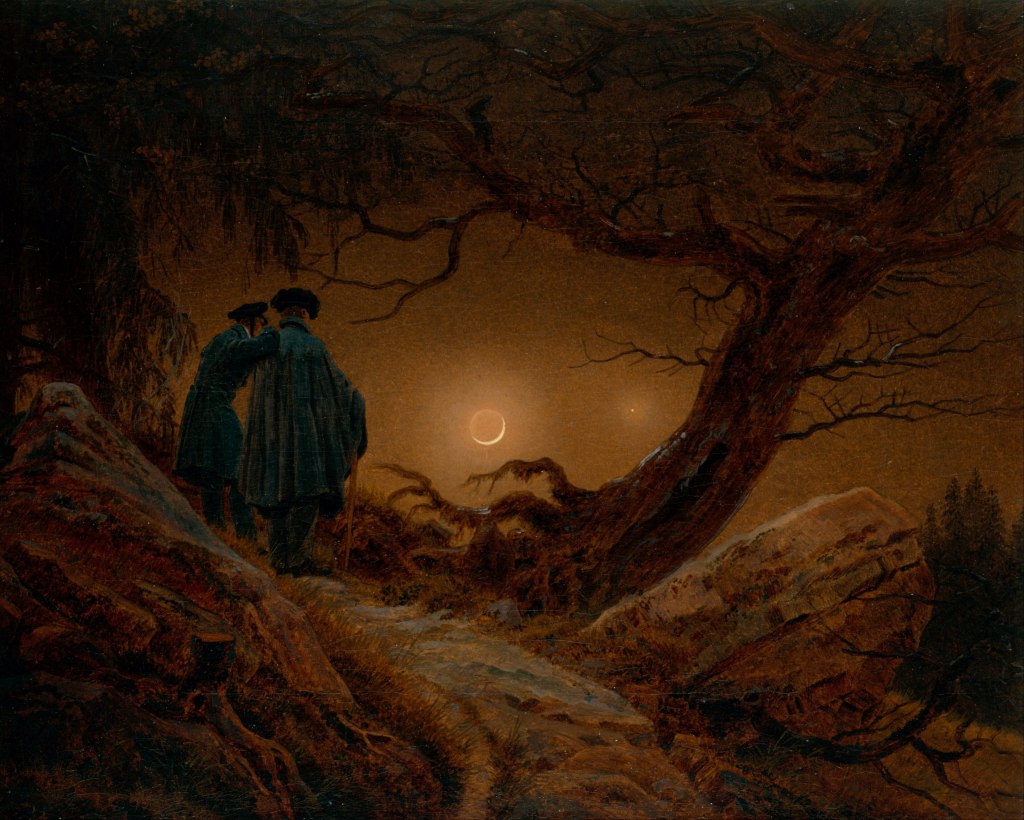
Written by: Ptolemy
‘Tinker Tailor Soldier Spy’
by John Le Carré
"For a master of deception and subterfuge,
You've made yourself quite the bed to lie in
Do your time-travelling through the tanning booth
So you don't let the sun catch you crying.

So predictable I know what you're thinking."

- "Body Paint" by The Arctic Monkeys.
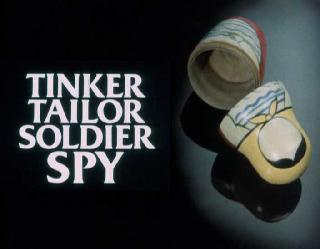
Some time ago, I wrote an article elsewhere about how the adaptations of Tinker Tailor Soldier Spy were interesting subversions of the Male Spy genre for the big and small screen. Even if they were relatively overlooked.
(Image from the Wikipedia Article of the 1977 BBC miniseries)
There were some things women spies can do well in espionage, and there were some jokes silly male spies can do well to tickle a laugh; neither, it seemed, were adequate in challenging the likes of James Bond and his masculinity-obsessed ilk.
None of these could be accused of not trying, but the effect of virtually every other “subversion” you could name boiled down to how every TV/Film spy is a kind-of James Bond. The spy character might be different every time, but the genre conventions were essentially the same: honour, fights, booze, and sex. All of them male-coded character decisions and actions, no matter who was doing them. It felt like you were only a good spy (or in the case of parodies and satires, not a good spy) if you could be measured up to someone like James Bond.
It was one of those articles where I had a lot to say, a lot I didn’t know how to say, and a lot I couldn’t say for the poor sake of time and attention. The whole thing, start to finish, was about 20 minutes of read time posted somewhere most “readers” can’t be bothered to read for more than 5 minutes.
Normally I didn’t care about the length, I cared about writing and editing. But that’s “Cooperating” with other writers for you.
There was reminder that I needed to gain a “better sense of proportion” (though not in so few words).
It was good advice to give but terrible to follow. I relented, keeping my article at the “barely readable” length it was now at the cost of a few sections omitted that explored a few more minute aspects. The style of speech, the apparent mundanity of spycraft, the imposed attitude of stoic ambivalence, and other things like that.
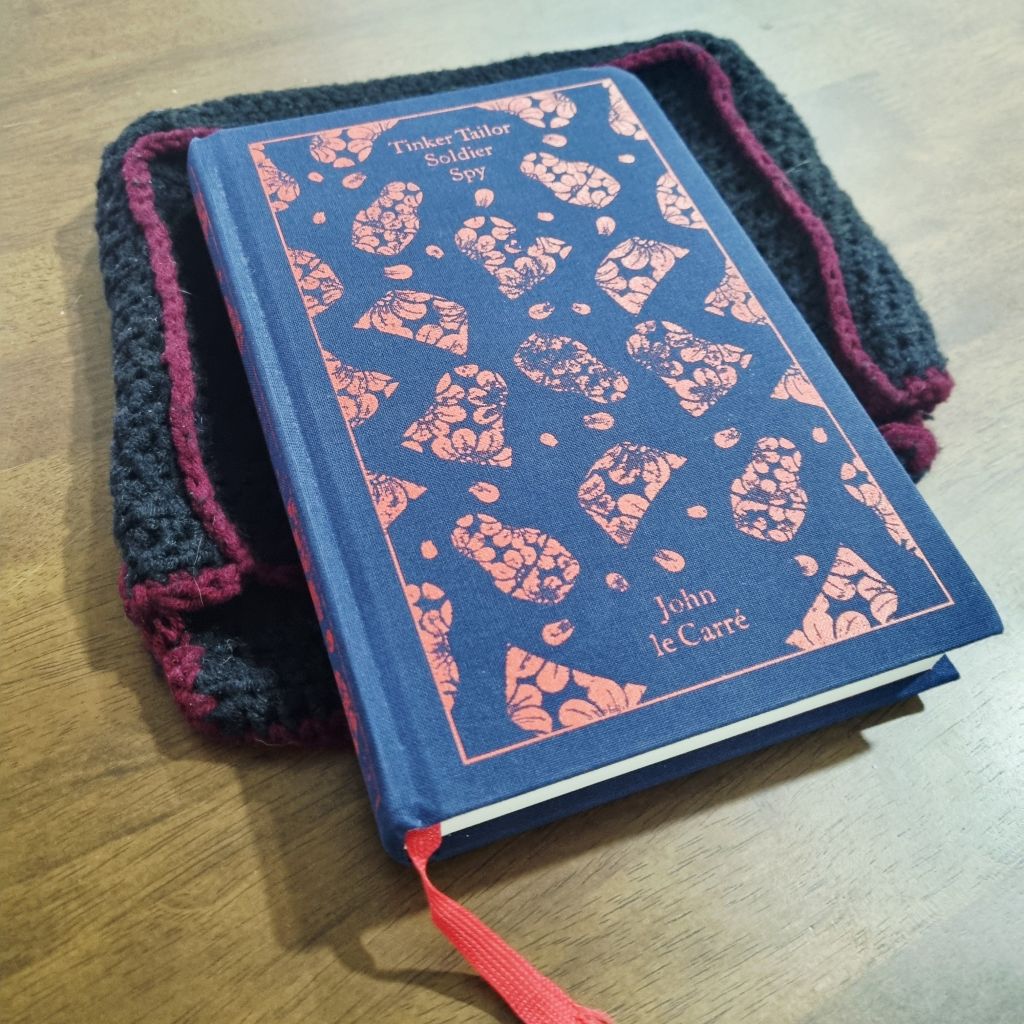
My old article focused on the 1979 BBC series and the 2011 movie adaptation, but (as is often the case) the original novel had more to meat than even my envisioned article could dare chew on.
(Image by me. This is the Coralie-Bickford Smith Penguin Books cover edition, which my sister helped me buy because she couldn’t find a cheaper copy. I crocheted the book sleeve following, and disobeying, this free pattern)
One of the things I think I’ve particularly struggled with in writing prose is the part where a character “thinks” to themselves.
It’s a different affair writing dialogue. I “hear” bits and pieces of dialogue to write down, and often that’s enough to establish some semblance of character. You can sound it out from the perspective of a listener. Do it right, and it’s deliberate, it’s measured. However, I often end up producing a rather taciturn tone of voice between descriptions and narrations.
Prose, as a somewhat important someone I can’t remember once said, is a meandering walk. You need to wander but your character comes around to the next narrative beat. Pressure mounts on the fact that your character’s wandering mind is itself treated as a dialogue, not between them and another character, but between the character and the reader.
Le Carré has this talent where parts of his prose sound like a specific form of hushed gossip you wouldn’t repeat aloud in a closed room. An old man recounting detailed information about people he knows to no one but himself. He recollects details of what he knew happened to a certain person, where a spy was stationed and why, the drinking habits of certain people, what he thinks of the weather, smart nicknames, and naturally accurate anticipations of peoples’ expectations.
Information, information, information.
Walk, wander, and roam.
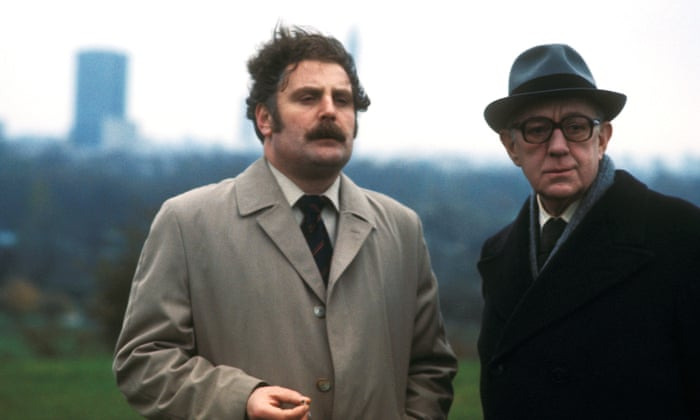
(Image sourced from this Guardian Article)
It’s something to try for myself, to be sure. It’s also something that can’t be captured in film/TV spies; you don’t see this gossip-y exposition in either adaptation of Tinker Tailor. Characters are just as stoic and restrained as you expect them to be when they’re on-screen. They’re only internally talkative. Here, you begin to see a side of characters and their thoughts that can’t be expressed through acting.
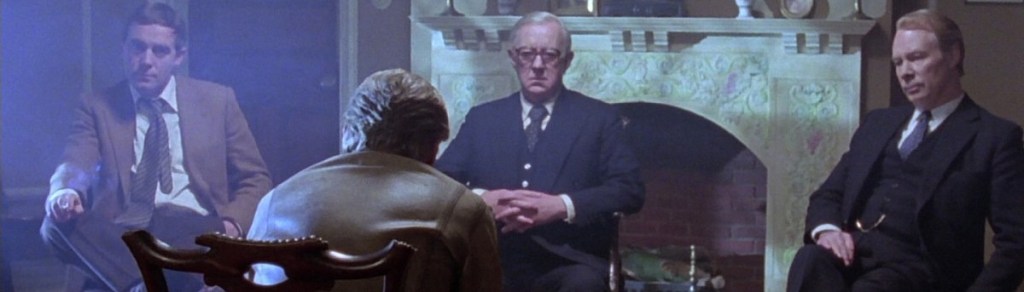
(Image file sourced from The Video File Blog)
Tinker Tailor is still a good subversion of the Spy genre today1. No over-the-top shootouts, no bad-ass fistfights. Sex happens elsewhere, to other people. There is espionage and information, but it’s an aspect of the genre that (I think) is treated with an asexual tone. All this to say that the only masculinity you find here is in the (alienating, indifferent) system the spies serve, not in the spy themselves. It’s a lesson. You can’t subvert a genre that’s incredibly entrenched in gender politics by simply changing one or two aspects of the main characters alone.
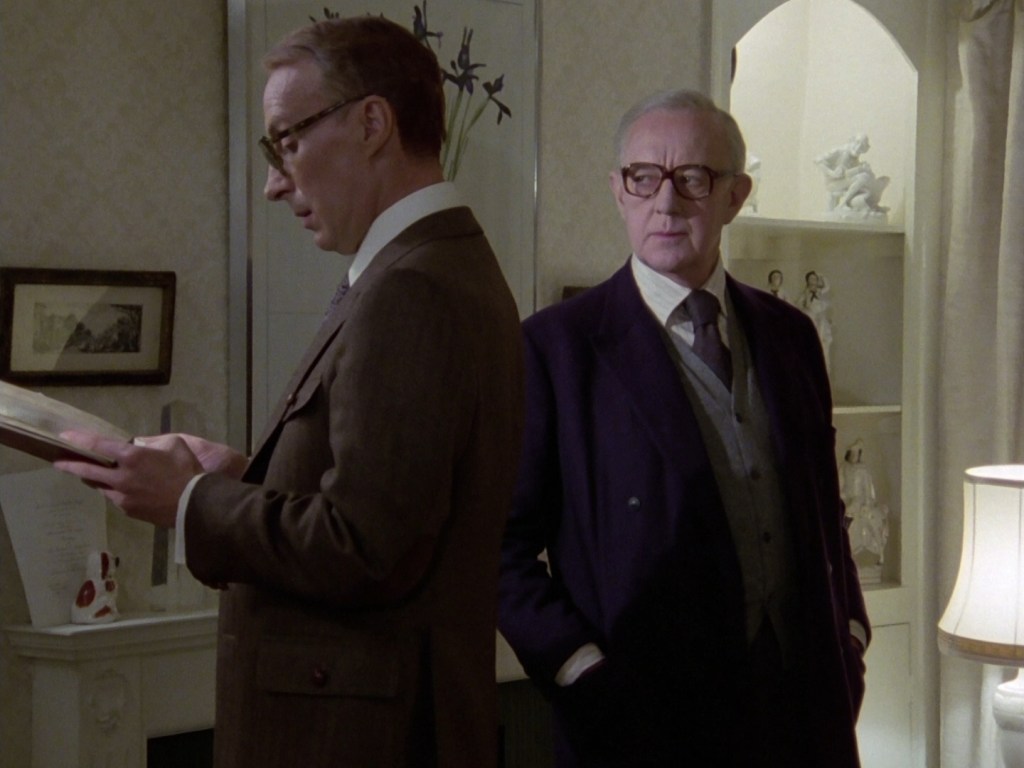
In Tinker Tailor‘s case, you simply follow the implicit and self-defeating gender ideology of the male spy to its natural conclusion: The spy grows old, and with age he will become feeble and impotent.
(Image file sourced from:
A hypothesis can be made that James Bond (as a franchise) has this fear of becoming “used up”, since the face of James Bond changes every once in a while. All of this as if to refresh and rejuvenate the idea of his (increasingly outdated) version of masculinity for every new generation of men while keeping the older ones on the hook.
Tinker Tailor‘s George Smiley, on the other hand, is “born old”. Outmoded, if not as a spy, then as a man and an identity. A white, upper-class, post-war, liberal British cuckold privately pining over the woman who left him for younger men. In his novel, he thinks a lot. His thoughts and feelings are put up for us. And from that we can conclude: He’s… boring, compared to many film spies anyway. The prime of Smiley’s identity was long gone even before the events of the novel, and to refresh Smiley the way we attempt refreshing James Bond impotently repeats the reflexive pain of a slow death.
 > After a lifetime of living by his wits and his considerable memory, he had given himself full-time to the profession of forgetting.

- Chapter 10, page 83
— Ptolemy
NOTES:
- Though, to be fair, I also think this particular interpretation of Tinker Tailor Soldier Spy and George Smiley is popular because we treat Tinker Tailor the same we treat Inferno in Alighieri’s Divine Comedy. People usually overlook the other two parts of the trilogy, and we plumb more meaning from the first. ↩︎
 Ptolemy Is Writing Again...

Leave a comment