
Written by: Ptolemy
‘The Crying of Lot 49’
by Thomas Pynchon
Thomas Pynchon has one of the greatest minds in literature for Conspiracy.
Granted, maybe I don’t read enough stories that feature some elaborate political conspiracy to make so broad a claim, but The Crying of Lot 49 is one of those books that make you go ‘huh’ at its cloudy revelations long after you’ve put it down.
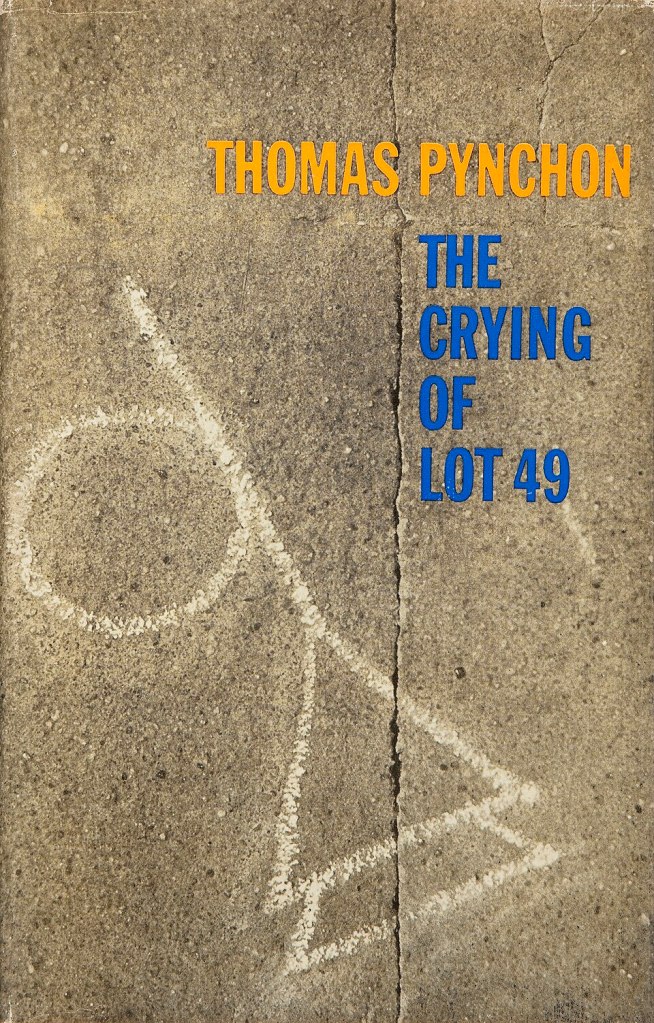
(Image from Wikimedia Commons)
When I tried tracking down more information on this book and for any specific relevations about its style and genre, I ran into the unhelpful consensus people often have when it comes to books of this period: It’s postmodernist.
I read the book. I know the signs. I should have seen this coming, but I had to try looking anyway.
Now, it could be a satire of literary postmodernism (as I’ve seen some souls somewhere claim it) or it is plain postmodernist (as many others assert it). The problem is that postmodernism is fully comfortable being confusing about its own sarcasm that the work itself is unsure if it is mocking or exemplifying its position.
“Death of the Author” is its primary theme, with an absurd conspiracy about postal systems somewhat proud that its true nature cannot be definitively pinned down. Oedipa Maas (yes, really) is figuratively yanked around odd West Coast locales seeking a sense of meaning in a conspiracy about two secret rival postal services that denounces any singular interpretation of its functions and origins.
The true circumstances behind her involvement in this conspiracy, the death of an ex named Pierce Inverarity, is wholly unclear: was Inverarity caught up in this deadly conspiracy? Was this all a hallucination caused by her doctor? Or did Inverarity manufacture every layer of this mystery just to fuck with her after he died?
Elements in the text fluctuate between being realistic and sounding completely made up. Characters and things have names like Mike Fallopian, Stanley Koteks, Dr. Hilarius, KCUF radio, and Genghis Cohen.
Other allusions have real-life correlates: the Thurn and Taxis postal company did actually exist, as do several other allusions to 60’s music and TV shows, its mention of thermodynamics and Maxwell’s Demon, and the artist Remedios Varo just to name a few.
I have a theme in this post, so I’ll parse the novel’s broadest elements through its lenses. Conspiracies tend to imply an unseen layer of truth which, through either discovery or by happenstance, seeps into the patterns of normal life. Details make their way through the gaps and once you know them, the perceived form of the original pattern changes. People don’t/can’t see life the same way anymore.
The Weird here manifests in the same way all mysteries dangle themselves in front of our eyes to our fascination. What is up with all these weird stamps? What is the W.A.S.T.E actually? What is Tristero? Is this all real or not?
The search for their answers take on a form of Lacanian Jouissance, where the enjoyment and allure of finding more and more partial ‘answers’ and clues become mixed up with pain, discomfort and suffering. Just like how some mysteries are more fun remaining as mysteries than as revealed answers. There is no actual joy in finding definitive proof, only a kind of mixture of pain and alluring pleasure in the pursuit of suggestions and answers. Oedipa Maas hates being part of this conspiracy, yet she can’t help but persist even at the very end where she was still looking for answers.
What’s intriguing is also how Pynchon achieved this effect: several clues and leads in the story contradict each other. The W.A.S.T.E and I.A seem to have multiple completely different yet equally plausible origin stories, while Tristero is either very real or just some director’s addition. The gap between what is true and what is perceived as true is flouted constantly, while us readers are also dragged along in this whirlwind by making connections of our own to Freud, Lacan, Greek Mythology, and 1960’s pop culture.
Friends know of my love for writing Alternate History fictions and the period of Mid-Century Modern aesthetics intervening the Modern and the Contemporary.
What I’ve never really discussed is Why.
Part of it is to do with the kind of breaking down of old modernist schools of thought and (once again) the liminal spaces in between what was thought possible and what is ‘actually’ possible. This has potential to feel more futuristic than the 2020’s for the simple reason that people still allowed themselves to imagine futures in more creative and less pessimistic ways.
(I sometimes say that the Cyberpunk genre, famous for being antagonistic about corporate capitalism and its effects, is hilariously outmoded now. In Cyberpunk, advanced futuristic technologies have the decency to exist parallel to pervasive and evil corporate activities. In real life, we only have the latter.)
Works like Disco Elysium (a topic for a future review like this), The Man in the High Castle, Do Androids Dream of Electric Sheep, Kubrick’s A Clockwork Orange, Otomo’s Akira, Bradbury’s Fahrenheit 451, and many others have a texture of a temporality beyond the presented time period their narratives occupy. Lot 49 is no exception to me.
Many of them feel, not only like a distant time, but a distant place where the staging of a new future is more possible than a contemporary setting. Futurism in the past feels more futuristic than the futurism of the present. The presentation of these textured and fictional time periods take on a profoundly weird, often conspiratorial form that hints at an Outside humanity has yet to discover in the actual present. An Outside, where the Weird and the Eerie happen inwards, there are new politics, new identities, and new futures.
This isn’t to say I have absolutely no faith a new future can be staged in the Here and Now, but that there is an allure to stage a possible form of futurism of your own. One right at the privatised collapse of modernist philosophy.
The Crying of Lot 49, being postmodernist, is fundamentally satirical because confusing irony and oversaturating satire is the best that postmodernism can manage for itself. There is plenty to like about the structure and conclusions of conspiracy and absurdism, as much as there is to dislike about how many men in this book are creeps. (Seriously, why are so many guys in this book so comfortable being pedos and nazis?)
But from a place where Sincerity and the Author supposedly ‘died’, a dozen radical new futures can emerge from the weird alternative histories they left behind.
-Ptolemy
Notes:
- Featured image on main page is from u/No_Restaurant_8638 on the r/LiminalSpace subreddit.
 Ptolemy Is Writing Again...
.jpg)
Leave a comment